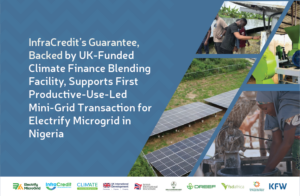
InfraCredit’s Guarantee, Backed by UK-Funded Climate Finance Blending Facility, Supports First Productive-Use-Led Mini-Grid Transaction for Electrify Microgrid in Nigeria
First DREEF-prepared project under the Climate Finance Blending Facility will link clean power to income-generating activity across nine communities in Jigawa State
Lagos | November 2026: InfraCredit, a ‘AAA’-rated specialised infrastructure credit guarantee institution, is pleased to announce its credit enhancement of Electrify Microgrid Limited’s (EML) local-currency debt financing for nine solar hybrid mini-grids across underserved communities in Jigawa State. The transaction is the first project prepared through the Distributed Renewable Energy Enhancement Facility (DREEF) to be financed under InfraCredit’s Climate Finance Blending Facility (CFBF). As part of that preparation, DREEF built a design led by the productive use of energy into the project to strengthen its commercial viability, linking reliable power directly to income-generating activity in the communities it will serve.
The transaction, supported through a co-financing arrangement under the CFBF, mobilises senior local-currency debt guaranteed by InfraCredit alongside concessional financing under the Facility.
The Project has been formally approved under the World Bank’s Distributed Access through Renewable Energy Scale-up (DARES) Performance-Based Grant Programme, administered by the Rural Electrification Agency (REA), Nigeria’s official agency for coordinating rural electrification. InfraCredit’s partnership with REA builds on the Memorandum of Understanding signed in August 2022 to develop financing pathways for private-sector mini-grid developers and expand access to long-term capital across Nigeria’s off-grid energy sector.
The Project draws on InfraCredit’s clean energy-financing ecosystem at every stage: from upstream project development and investment readiness, through concessional risk-sharing and credit enhancement, to the mobilisation of domestic institutional capital. Each part addresses a different constraint that holds developers back, so that a viable project can reach financial close and attract long-term local-currency funding.
The CFBF, managed by InfraCredit, combines subordinated first-loss capital from development partners, including the UK Foreign, Commonwealth & Development Office (FCDO) and British International Investment (BII), and technical assistance from other development partners, alongside InfraCredit’s local-currency guarantees. FSD Africa’s technical assistance supported this Project by helping eligible first-time issuers with the technical, legal, environmental and social due diligence needed to prepare climate-aligned infrastructure for local-currency financing. The structure is designed to unlock participation from domestic institutional investors, including pension funds and insurance companies, in distributed renewable energy projects by addressing the financing and risk constraints that have historically held them back.
This reflects a broader market-building goal: strengthening the pipeline of investment-ready projects while building financing structures that let more domestic capital participate in clean energy infrastructure.
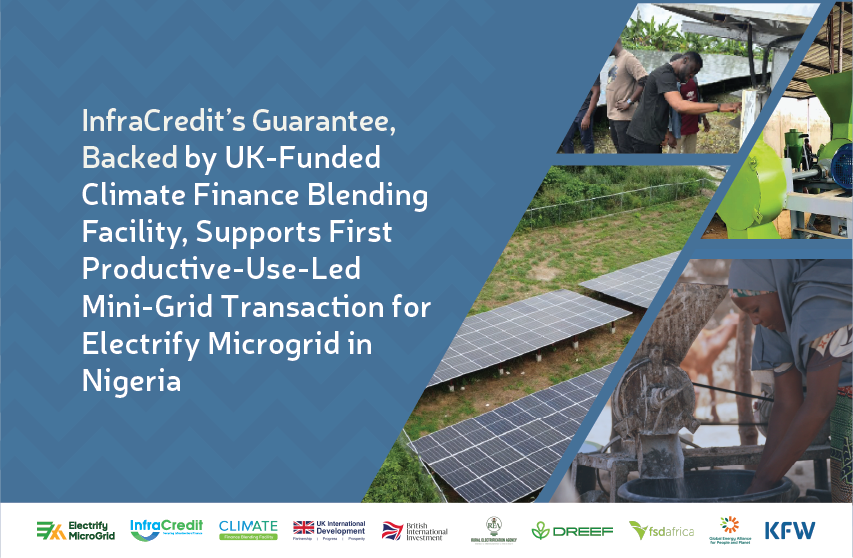
The nine mini-grids, with a combined solar generation capacity of 609.0 kWp, will include battery storage and inverter systems and are expected to serve approximately 4,557 residential, commercial and productive-use connections, reaching more than 22,000 people and 400 businesses. Sites were selected based on distance from the existing grid and the high cost of extending conventional grid supply to these communities.
This builds on the CFBF’s growing track record: approximately ₦24 billion in financing mobilised across nine developers so far, with projects expected to reach over 79,000 beneficiaries, create more than 5,500 jobs, and install approximately 5.53 MW of off-grid solar capacity as they come online. The Facility also has a mandated pipeline of approximately ₦243.31 billion across 23 developers seeking financing, underscoring its growing role in bringing private capital into Nigeria’s clean energy transition.
The productive-use design was developed through DREEF’s project preparation work. A productive-use assessment commissioned by InfraCredit, with technical assistance from British International Investment (BII), examined commercial activity, affordability, production capacity and equipment needs across all nine sites to identify viable productive-use hubs that could anchor demand for the mini-grids. The resulting design includes solar-powered equipment for rice and groundnut processing, irrigation, grain milling, and electric mobility, intended to strengthen daytime electricity demand, support more predictable cash flows, and improve the commercial sustainability of the mini-grid portfolio.
Beyond the productive-use design, DREEF also closed the wider investment-readiness gap that often prevents viable distributed renewable energy projects from reaching financial close. Backed by KfW and the Global Energy Alliance for People and Planet, DREEF supports project development and investment readiness for distributed renewable energy projects more broadly. For this Project, EML entered a Joint Development Agreement with DREEF to strengthen the technical robustness and bankability of its mini-grid pipeline, covering site assessments, bills of quantities, financial modelling, contractual arrangements, implementation planning, and the business and financing materials needed to bring the Project to financial close. The Project’s base-case assumption of 4,557 connections draws on DREEF’s own site enumeration and customer surveys, alongside REA’s Village Data Analytics (VIDA) geospatial data as a complementary reference.
Construction financing is further supported by InfraCredit’s Construction Finance Warehouse Facility (CFWF), a bridge financing instrument funded by the Nigeria Sovereign Investment Authority (NSIA) that provides short-term liquidity ahead of long-term refinancing through InfraCredit-guaranteed bonds.
Construction and operation of the mini-grids is expected to create up to 399 direct jobs, around 15% of them for women, while avoiding an estimated 888.27 tonnes of carbon emissions annually. The productive-use component extends these benefits further, supporting 39 identified processors, 11% of them women, with agricultural processing equipment to improve output and income.
Statements
Ms. Jojololami Ngene, Chief Executive Officer of Electrify Microgrid Limited, said:
“This transaction represents an important milestone in EML’s mandate to develop, finance, build and operate commercially sustainable mini-grid infrastructure that goes beyond electricity access to enable productive and inclusive economic activity. Through our Energy-as-a-Service model, we are building reliable, affordable and clean power systems designed around the needs of the communities and enterprises we serve. The integration of productive-use applications is central to this approach, supporting agricultural processing, irrigation, small businesses and other income-generating activities while strengthening livelihoods, local enterprise and the long-term sustainability of the mini-grids. We are grateful to InfraCredit and our development partners for supporting EML through this important development and financing journey”.
Mr. Chinua Azubike, Chief Executive Officer of InfraCredit, said:
“With EML, the question was not simply how to finance nine mini-grids. It was how to make sure the power they generate becomes part of how communities in Jigawa State earn a living. That is why productive use was built into the project from the start. DREEF prepared the project around the income-generating activities the power will serve, and technical assistance, concessional capital and InfraCredit’s guarantee brought it to the point where local-currency debt could follow.
Much of that work happens before the transaction and is often less visible than the financing itself, but it is what determines whether a project stands alone or opens the way for others. As our first productive-use-led mini-grid transaction, EML shows what becomes possible when projects are prepared to be financeable and power is tied directly to livelihoods. Our aim is to make that pathway repeatable, so that domestic institutional capital can participate at scale.”
Dr Paul Healey, Head, Private Sector and Green Growth, at the British High Commission in Nigeria, said:
“The Climate Finance Blending Facility, managed by InfraCredit and supported by the UK, continues to demonstrate how concessional finance can help unlock domestic capital for Nigeria’s clean energy transition. This transaction is particularly significant as the first DREEF-prepared project to reach financing through the Facility, demonstrating how project development support can help bring investment-ready distributed renewable energy projects to market. By combining this with InfraCredit’s local-currency credit enhancement, the Facility is helping to mobilise domestic institutional capital and strengthen the foundations for a deeper clean energy investment market in Nigeria.”
Dr. Abba Abubakar Aliyu, Managing Director of the Rural Electrification Agency, said:
“The value of these nine mini grids lies in what reliable electricity will enable people to do, from growing a business to processing produce and earning a better income. Reaching financial close is an important step towards making those opportunities possible.
I appreciate InfraCredit’s role in enhancing Electrify Microgrid Limited’s local-currency debt financing. This is the kind of collaboration we want to build on through DARES, our programme to expand renewable energy access. By bringing grant support and private financing together, we can help capable developers move projects forward and deliver electricity that supports livelihoods in underserved communities.”
Mr. Geoffrey Manley, Director and Head of I&C Debt Africa and South Asia at British International Investment said:
“We are delighted to support the development of mini-grid projects through our technical assistance, building on the commitment we made through our partnership with InfraCredit. Supporting productive use of electricity is a key driver of mini-grid long-term sustainability. Off-grid solutions are critical to expanding reliable energy access while enabling businesses and livelihoods to thrive. This is also aligned with BII’s ambition for 40 per cent of our new commitments to qualify as climate finance under our 2026–31 strategy.”
Ms. Carol Koech, Vice President for Africa, Global Energy Alliance for People and Planet, said:
“Many viable renewable energy projects stall before financial close, not from lack of promise, but from missing the technical groundwork investors demand. DREEF closes that gap. This transaction proves what that support delivers: bankable projects, stronger pipelines, and real progress toward Mission 300’s goal of powering 300 million Africans by 2030. With World Bank backing and alignment to Nigeria’s $750 million DARES programme, DREEF shows the model we need more of: turning preparation into power, and potential into economic opportunity.”
Mr. Johannes Scholl, Head of Division, Africa, Equity & Funds, KfW, said:
“KfW is pleased to support the development and investment readiness of this project through DREEF, building on its long-standing partnership with InfraCredit. The financing of these nine sites demonstrates how targeted project preparation and strong institutional partnerships can help mobilise capital for sustainable energy infrastructure, expand reliable electricity access and create economic opportunities in underserved communities in Nigeria.”
For more information, please contact
Infrastructure Credit Guarantee Company PLC
Media Enquiries: [email protected]/[email protected]
Guarantee Enquiries: [email protected]
Phone: +234 6312300
Note to the Editor
About InfraCredit
InfraCredit (www.infracredit.ng) was established in 2017 as a first-of-its-kind ‘AAA’-rated specialised infrastructure credit guarantee institution, created to support long-term local currency infrastructure financing in Nigeria. InfraCredit’s guarantees act as a catalyst to attract long-term domestic institutional capital from pension funds, insurance firms, and other investors into creditworthy infrastructure projects, thereby deepening Nigeria’s debt capital markets.
InfraCredit is backed by the Nigeria Sovereign Investment Authority, KfW Development Bank, International Finance Corporation, and domestic institutional investors including Leadway Assurance, Access ARM Pensions, and CardinalStone Pensions.
In April 2025, InfraCredit became a publicly listed company and was admitted to trading on the NASD OTC Securities Exchange, marking a significant step in broadening domestic institutional ownership. It maintains the highest domestic financial strength ratings accorded to any financial institution by Agusto & Co., Global Credit Ratings, Intelligence Africa, and Fitch Ratings, which has rated InfraCredit two notches above Nigeria’s sovereign rating. InfraCredit is the subject of two Harvard Business School case studies taught in the HBS MBA programme.
About EML
Electrify Microgrid Limited (EML) is a Nigerian renewable energy company established in 2022 and focused on accelerating rural electrification through the development, financing, construction and operation of distributed renewable energy infrastructure. The Company adopts a Develop, Finance, Build, Operate and Maintain (DFBOM) model and partners with renewable energy developers to deploy commercially sustainable mini-grid solutions across underserved communities. EML currently operates and manages mini-grid assets within Nigeria and maintains a growing development pipeline spanning multiple states across the country.
About CFBF
The Climate Finance Blending Facility is a catalytic facility capitalised with USD21.3 million concessional funding by the UK Foreign, Commonwealth & Development Office (“FCDO”) and the British International Investment (“BIl”) to mobilise additional funding from development partners to co-finance off-grid clean energy investments alongside InfraCredit’s local currency guarantees in Nigeria.